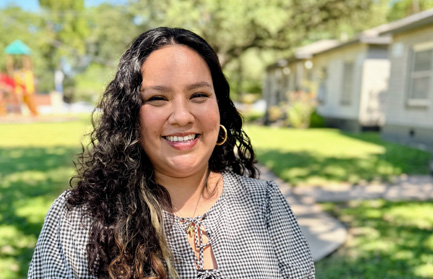

When Magenta got a letter in the mail about a new homeownership opportunity on Austin’s East Side, her first instinct was to throw it away.
“I thought it was too good to be true. There is no way there’s a house on the east side of Austin for $156,000. There’s no way. But I called.”
That phone call changed everything. It was the culmination of decades of hard work, resilience, and a quiet, unwavering determination to build something permanent — for herself and for her children. Magenta’s journey from housing assistance to homeownership is not a story about luck. It is a story about what is possible when someone refuses to stop.
Roots in Eagle Pass, Dreams in Austin
Magenta’s story begins far from Austin. Born in San Antonio to a mother who was still in college, she was raised by her grandparents in Eagle Pass, Texas — hardworking, education-first people who shaped the woman she would become.
“My grandpa would always say being on time is being late. If you’re early, then you’re on time.”
She was a straight-A student with a near-photographic memory — the kind of kid teachers remember. Her dream was to become a UT cheerleader and a pathologist, to go to the university she had always admired from afar and work in medicine like so many in her family. At 13, she followed her mother to Austin and planted herself firmly on the East Side, in the Riverside area and the Rosewood neighborhood. She had big plans.
And then life happened, the way it does.
Doing What She Had to Do
Magenta had her first daughter at 17. She dropped out of school. She worked. But she was, as she puts it, “way too smart for this” — and she knew it.
When Garza High School opened on the East Side with a flexible, work-and-learn model, she enrolled. Travis High School had told her it would take a year and a half to finish her diploma. She graduated from Garza in three weeks — with honors — and delivered the graduation speech.
What followed were years of reinvention. She waitressed at IHOP for six years. Arthritis in her shoulder ended that chapter. She pivoted to accounting, earned her certification as an administrative assistant, and worked her way through attorney’s offices, schools, and veterinary hospitals — always in customer service, always with people, always excelling.
Eventually, she landed at the Public Utility Commission of Texas, where she has worked for nearly a decade. After Winter Storm Uri, when the legislature created the Office of Public Engagement to better connect Texans to the PUC’s work, her supervisor — who had been promising for years, “if I ever become a director, you’re coming with me” — made good on his word.
Today, as a Public Liaison, Magenta is the go-to resource for an entire office. The attorneys ask why she didn’t go into law. The engineers ask why she didn’t go into engineering. Her boss has a name for the way she handles even the most difficult callers: the Magenta Magic.
“You could get a person that’s about to jump through the phone and kill you, and by the end of the call they’re saying, ‘I’m so sorry I was so rude — you were so nice.'”
What Housing Assistance Really Looks Like
Through all of it — the job losses, the pivots, the raising of three daughters largely on her own — Magenta had a safety net: the Housing Choice Voucher program.
She didn’t stumble into it. She stood in line for six hours the day the waitlist opened. Then she waited nearly four years to be selected.
“It wasn’t something that was just handed to me,” she says firmly. “And once I got it, I took care of it. I didn’t take advantage of it. I still worked. I still took care of my place.”
When she lost her job after the attorney she worked for retired, the voucher kept a roof over her family’s heads. She knew the stigma that followed the program — and she pushed back against it quietly, consistently, every time she got her deposit back, every time a landlord told her she was one of their best tenants.
But Magenta always understood the program as a bridge, not a destination. As her income grew, AHA was helping her with just $52 a month in rent. She stayed on anyway — because, as her mother reminded her, any help is better than none.
The goal, however, had always been the same: get off assistance and build something of her own.
“Being on Section 8 was a blessing — a huge blessing. And because of that program, now I’m able to buy a home. The Austin Housing Authority did so much for me to get me to where I am now.”
Choosing to Let Go
When Magenta’s income climbed above the program threshold, the path forward was clear — but that didn’t make it easy. Leaving the safety of assisted housing while Austin’s housing market raged around her felt like stepping off a ledge.
She looked at houses in Buda, Kyle, Bastrop, Elgin. Too expensive. She looked into mobile homes. Too expensive. She thought about downsizing to a smaller apartment when her kids pushed back: we want our own rooms.
Relinquishing her voucher, when the moment came, was deliberately simple. She wrote a letter. She sent an email. The process, she says, was easy — because she had taken care of her responsibilities every step of the way. She had nothing complicated to unwind.
“I had messaged the person doing my renewal and said, how do I say I don’t need this anymore? And he said, you just write a letter. And that was it.”
It was one of the clearest moments of her life: the recognition that she had crossed the line she had always been walking toward.
The Letter That Changed Everything
Just as she was staring down the reality of Austin’s housing market alone — genuinely, deeply discouraged — the letter from AHA arrived.
Prospect Heights. Twelve townhome-style homes for sale to first-time, low-income buyers. Built through a partnership with Austin Habitat for Humanity, right at Rosewood Courts, in the heart of the East Austin neighborhood where she had spent her whole Austin life. $156,000.
She thought it was a scam. She called anyway.
It was real.
Building Her Own Home — Literally
Through the Habitat for Humanity partnership, prospective homeowners don’t just wait for a house to be built — they help build it. Magenta showed up to volunteer. She learned to cut wood with a saw. She built a linen closet from scratch. She worked alongside Habitat volunteers, including a woman in her 80s who was climbing ladders and running a nail gun.
“I want to be her when I grow up,” Magenta says.
She had always told herself she wasn’t good with her hands. The build site proved her wrong. Working with Home Depot — one of the project’s sponsors — she found herself learning volunteers’ stories, understanding why they give their time, feeling the full weight of community showing up for community.
“I learned that I got what it takes to do this. I was doubting myself. Now I know.”
Home Is Stability. Home Is Equity. Home Is Something to Leave Behind.
Ask Magenta what home meant to her growing up, and she’ll tell you about her grandparents’ house in Eagle Pass — a modest house, a poor family, but a house. When her grandfather died and her uncle sold it, something in her grieved.
“Just knowing that house was there meant a lot. I’ve always wanted to have a place for my kids to say, ‘I’m going home this weekend’ — same place. Not moving all over, because we moved a lot.”
Ask her what home means to her now, and her answer is immediate: stability.
“Equity. Leaving my kids something. My mom lost her house in the divorce. She’s been on housing assistance. We’ve been on housing for so long — I want to break that cycle. I want my kids to always have somewhere to come back to. Thanksgiving, Christmas. I love to cook. Everybody come on over.”
She is also quietly, deliberately building the next generation’s foundation. Her oldest daughter — her best friend, her coach through life — is going on the deed. “If anything happens to me, the house goes directly to her.”
The cycle, in Magenta’s hands, is breaking.
A Message to Anyone Who Doubts
Magenta has one thing she wants everyone to know.
“There is help out there. Look for resources. Don’t shy away. Don’t think you can’t do it.”
“Purchasing a home is not just a dream. It’s a reality. You can do it. And if you have any doubts — look me up. I will put some motivation in your heart.”
The Austin Housing Authority is proud to walk alongside residents like Magenta — not just to provide housing, but to support the journey toward independence and stability. Prospect Heights at Rosewood Courts represents exactly that promise: an opportunity rooted in East Austin’s history, reaching toward its families’ futures.
Magenta is just the beginning.